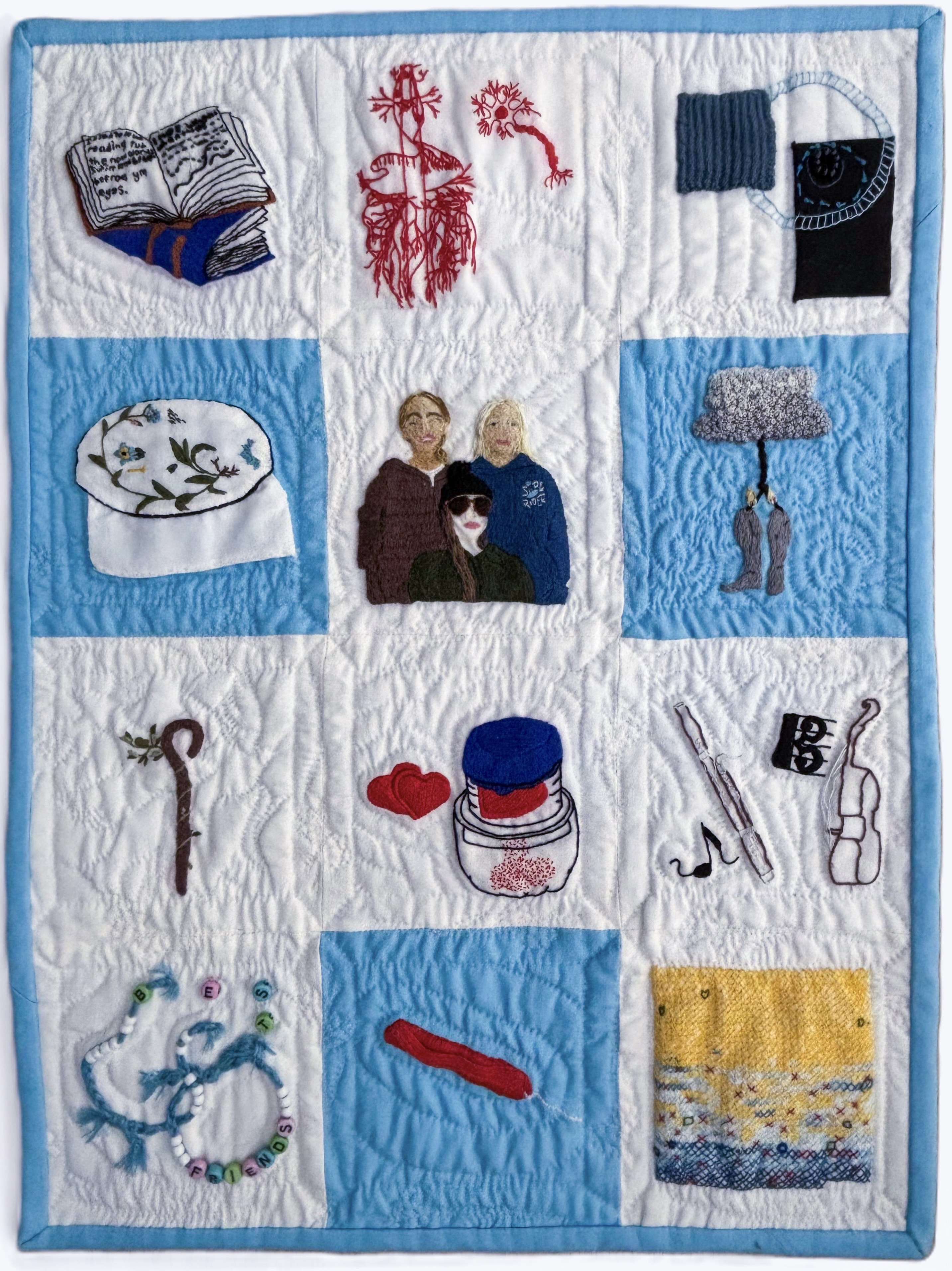
Click on a square to read about the embroidered image and what it means to me.


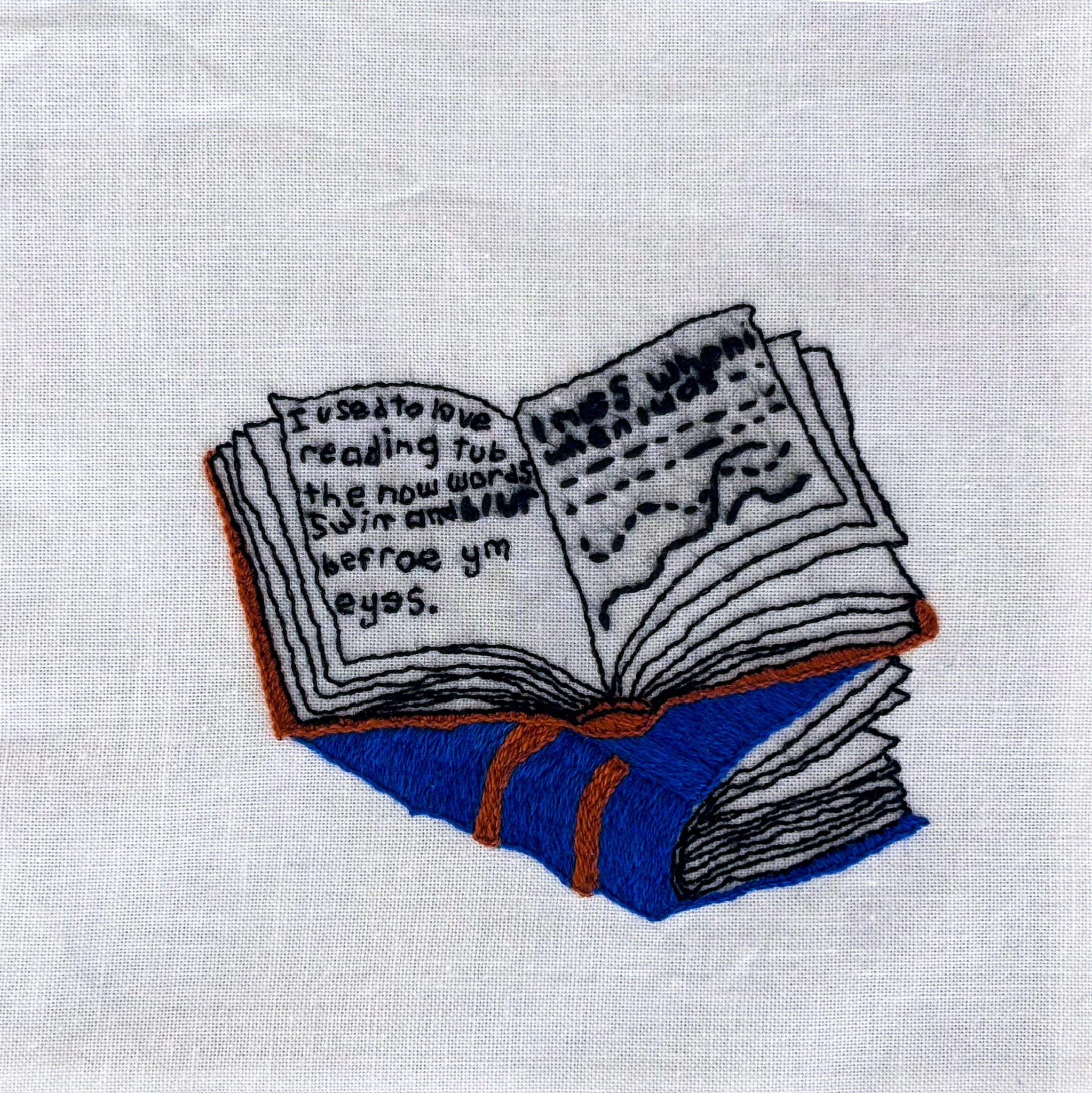
On top of a blue leather-bound book, a brown book lies open, reading “I used to love reading tub the now words swim and blur befroe ym eyes.” in increasingly garbled text. Embroidered on white cotton.

inFo graB

I’ve always been a bookworm. From kindergarten flashcards, I soon escalated to consuming every series my libraries held. As a child, I’d travel through time with Dear Canada, Nancy Drew, and Anne Shirley. Warrior Cats offered escape and a bridge to friendship. Reading was a secret language of adventure and understanding.

As I grew, my palate matured into To Kill A Mockingbird, Tuesdays with Morrie, and The Ministry of Truth, eventually leading to scientific and theological texts. But as my digestion slowed, so did my cognition. I remember chewing through research for answers while seeking comfort in characters whose struggles mirrored my own. When physically reading became too much of a feat, audiobooks offered relief.

I miss turning pages, but I’m so grateful for services such as CELA that keep reading accessible!
Back to Top


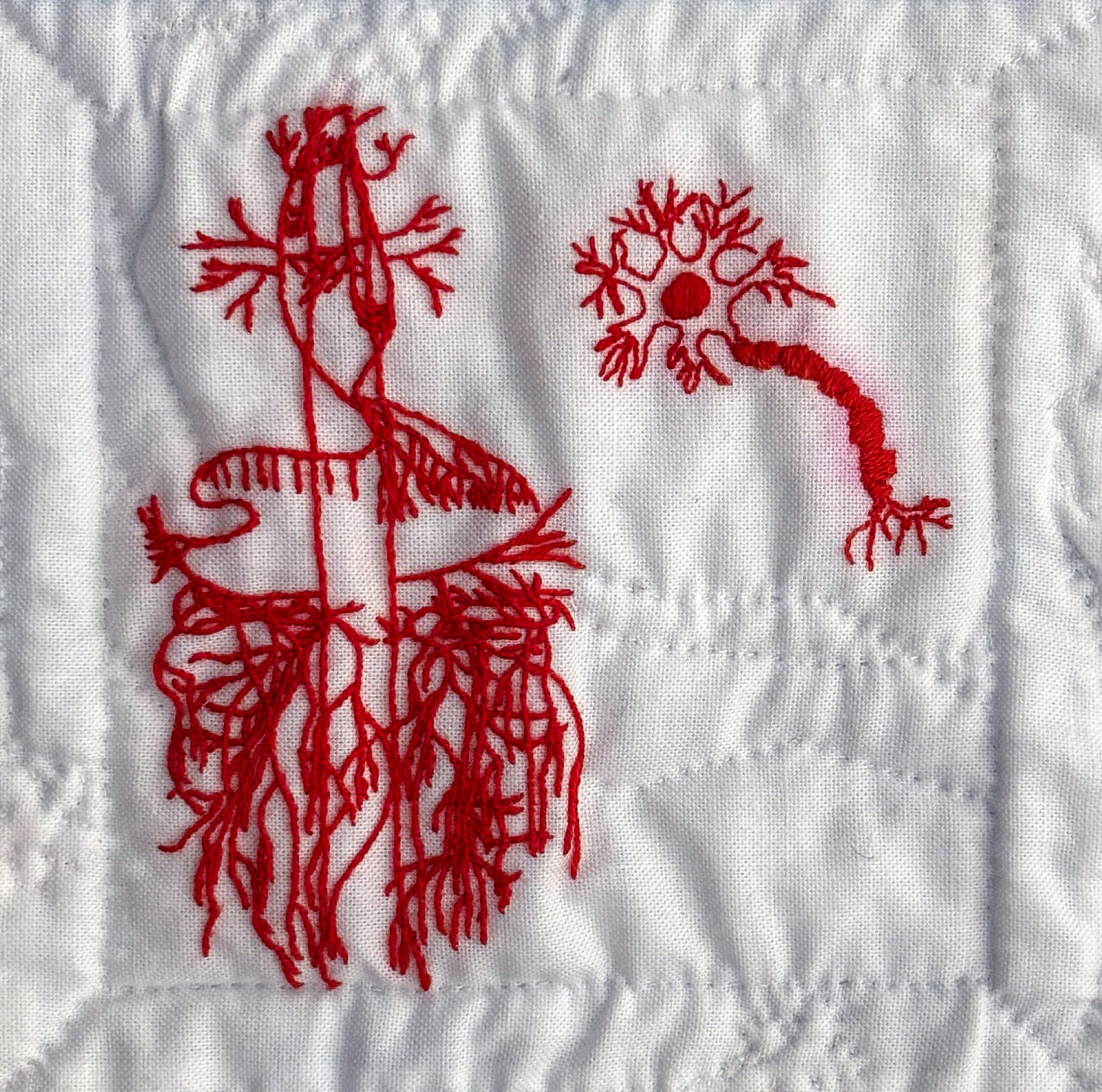
Redwork embroidery of the vagus nerve and a neuron on white cotton.

Misfiring

My fascination with neuroscience was first expressed through science fair projects with my friend, assessing the impact of cognitive interference on the ability to process information. I loved collaborating to design experiments and analyze data to present our findings. This interest took on a personal weight as I began learning about M.E. Ron Davis’s groundbreaking and dedicated research intrigued and uplifted me. Then, at one of my lowest emotional points, the Remission Biome project provided support and an opportunity to participate in community science. Leaning into digital connection, artist and musician Lia Pas’s incredible embroidery and advice helped me get started, modelling an artistic practice reshaped by M.E., for awareness and community support.

Misfiring, through the embroidered vagus nerve and myelin-degraded neuron, is an homage to the work of scientists, artists, and organizers whose significant contributions nurture the M.E. community.

Back to Top


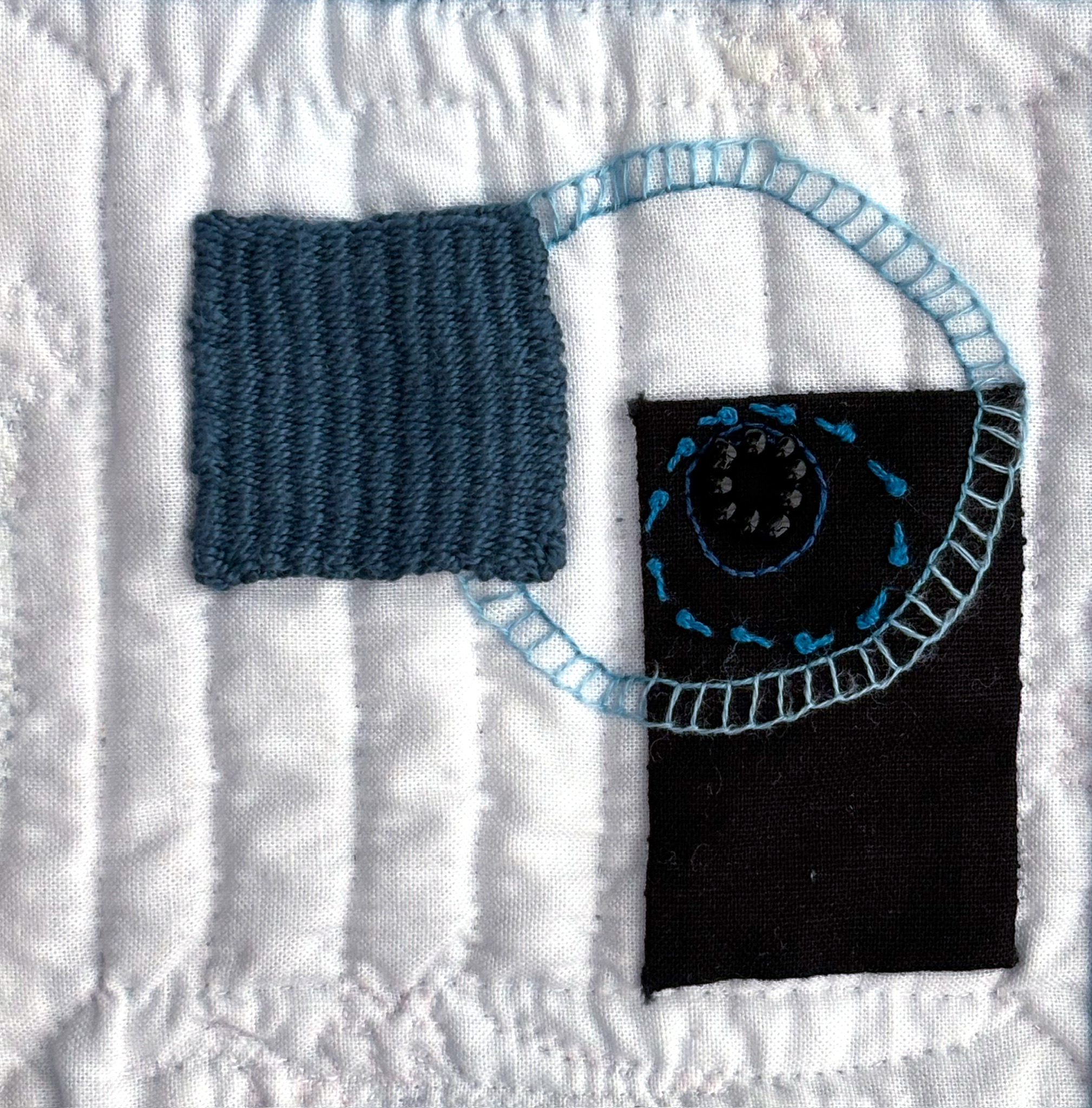
A handwoven blue square and a black cotton rectangle appliquéd on white cotton. Four concentric circles in various shades of blue are embroidered. The innermost circle, made of black beads, sits in the upper left of the black rectangle, down right of the blue weaving while the outermost circle overlaps the rectangle and is partially covered by the blue textile.

Circumscribed

Through the abstracted floor plan of my room, Circumscribed charts the eroding worlds of those with increasing severity of M.E.:


Healthy, Bell 100, FunCap 6
Floating
Mild, Bell 30, FunCap 4
from deadline to
Moderate, Bell 20, FunCap 3
Function, pressing against
Severe, Bell 10, FunCap 2
embedded bounds; thrown into the
Very Severe, Bell 0, FunCap 1
Abyss

They are increasingly impermeable: smaller bounds to the world; harder to occasionally push those bounds; greater consequences of breaching those bounds.

Back to Top


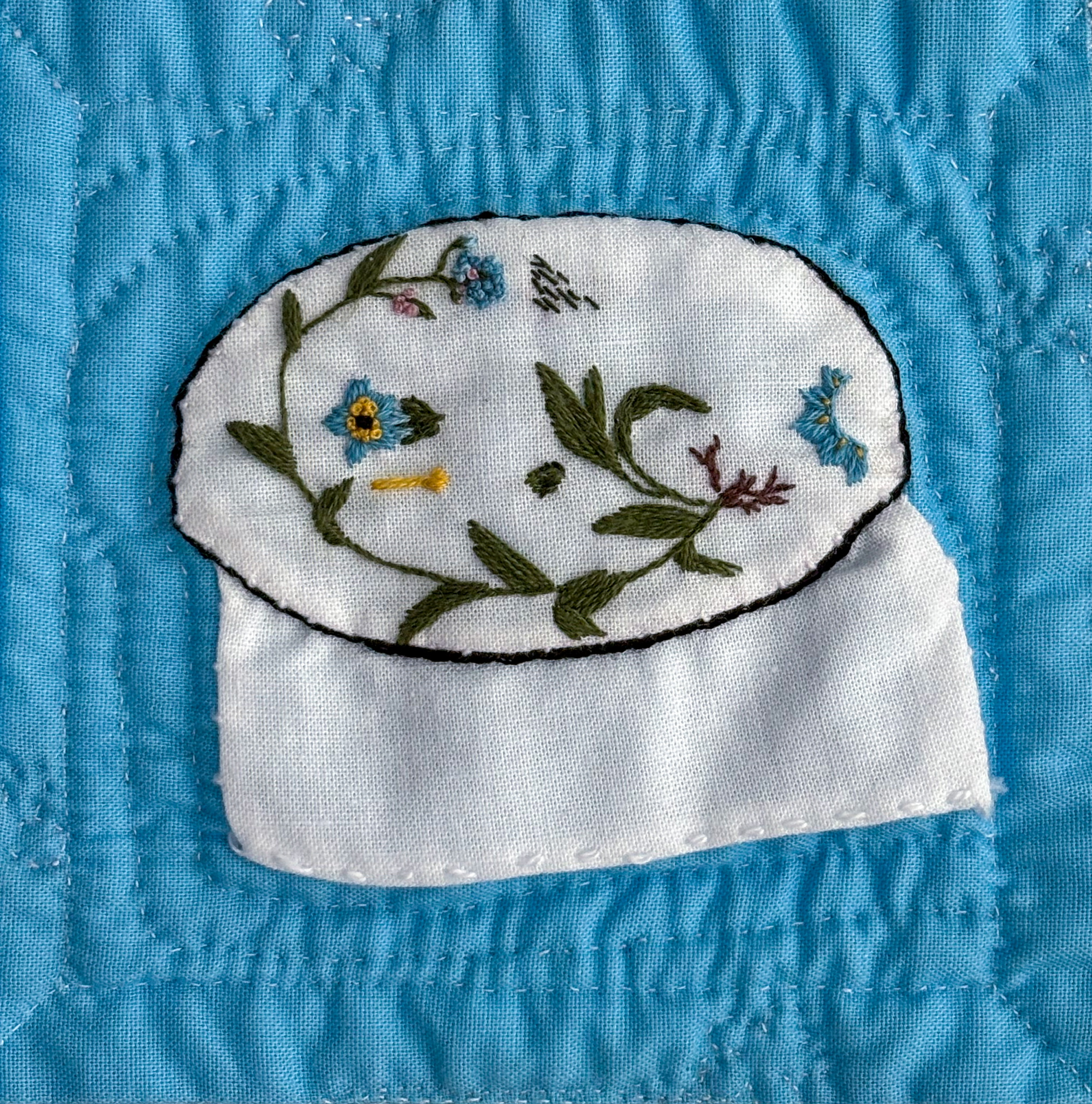
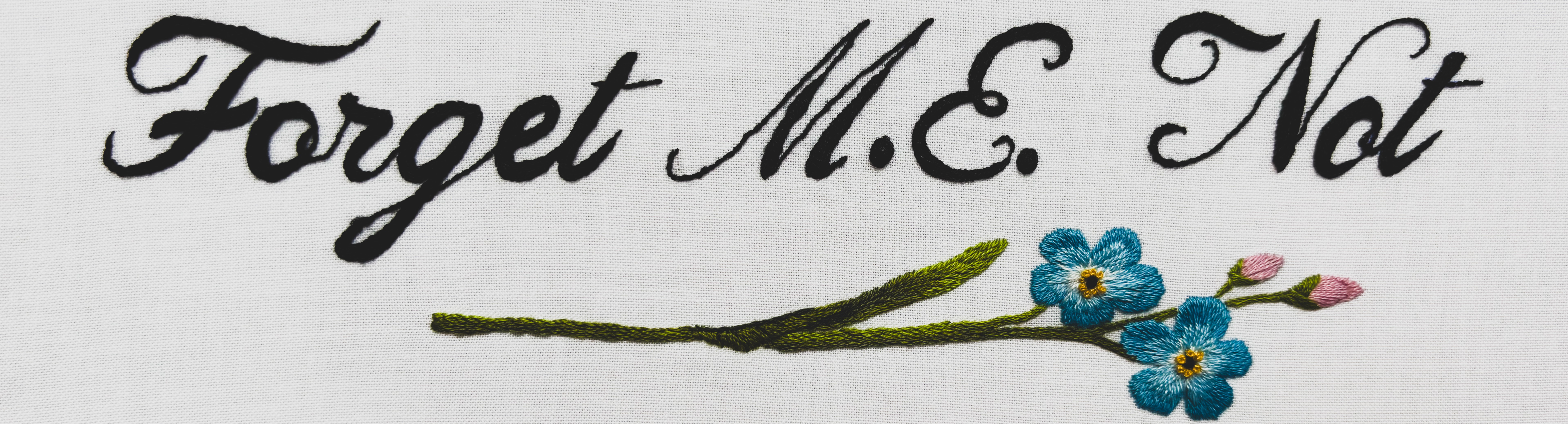
Forget me not botanical embroidery on white cotton, appliquéd on blue cotton to depict fabric in an embroidery hoop.

Bloom/rooted

This piece, nodding to a continuing series, is a celebration of embroidery and the M.E. community.

The botanical illustration, merging some of my passions, alludes to the comfort and satisfaction I found in slow, tangible needlework when I went dormant, unable to work towards my former aspirations.

The flower, symbolic of the M.E. community, exemplifies flourishing through solidarity, even in desert lands.

Back to Top


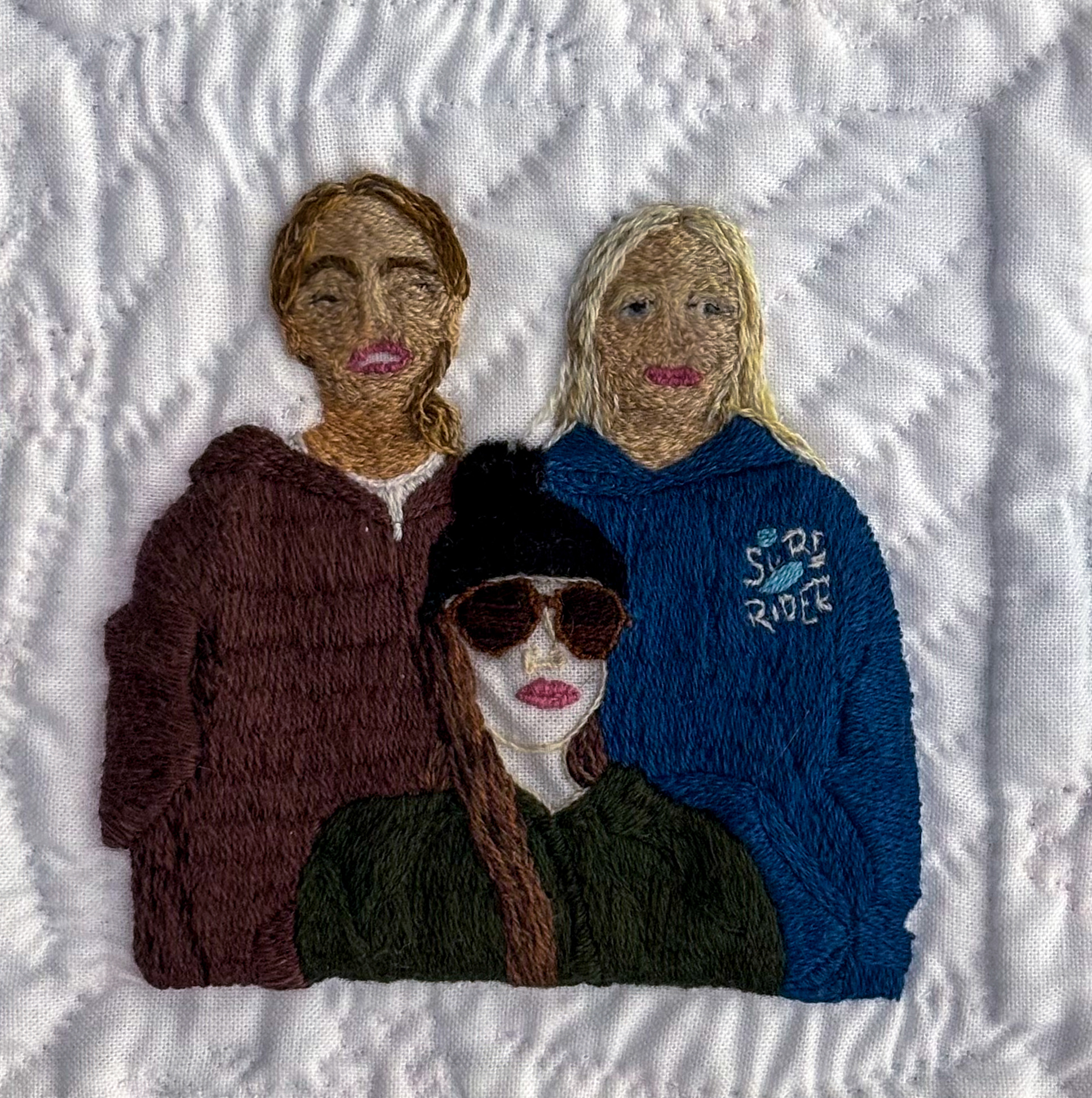
Three young women, embroidered on white cotton. In the foreground, an outlined woman in a toque and sunglasses sits, dressed in a forest green sweater. Just behind her stand two smiling women, densely stitched. On the left, an auburn-haired woman in a brown zip-up grins next to a blonde woman wearing a vibrant blue hoodie with a “Surf Rider” emblem.

Millions Missing

This portrait of my sisters and me captures a rare moment of togetherness, in stark contrast to a life defined by physical isolation. Their solid presence illuminates my liminal state; a fleeting moment our disparate realities align.

Participating is a feat of invisible labor, achieved at a profound metabolic cost. My toque and sunglasses: sensory shields to briefly inhabit a shared space. Yet, as I cherish these moments, my mind oscillates between connection and retreat as physical and cognitive energy expenditure pulls me into a void.

My translucence depicts the invisibility inherent to severe M.E.: a condition necessitating near-total absence from everyday experiences. Even when physically in-frame, the self is sidelined by a disease largely misunderstood and ignored.

This piece captures systematic displacement: the shared reality of the #MillionsMissing calling for recognition and care that honours their inherent value regardless of perception.

Back to Top


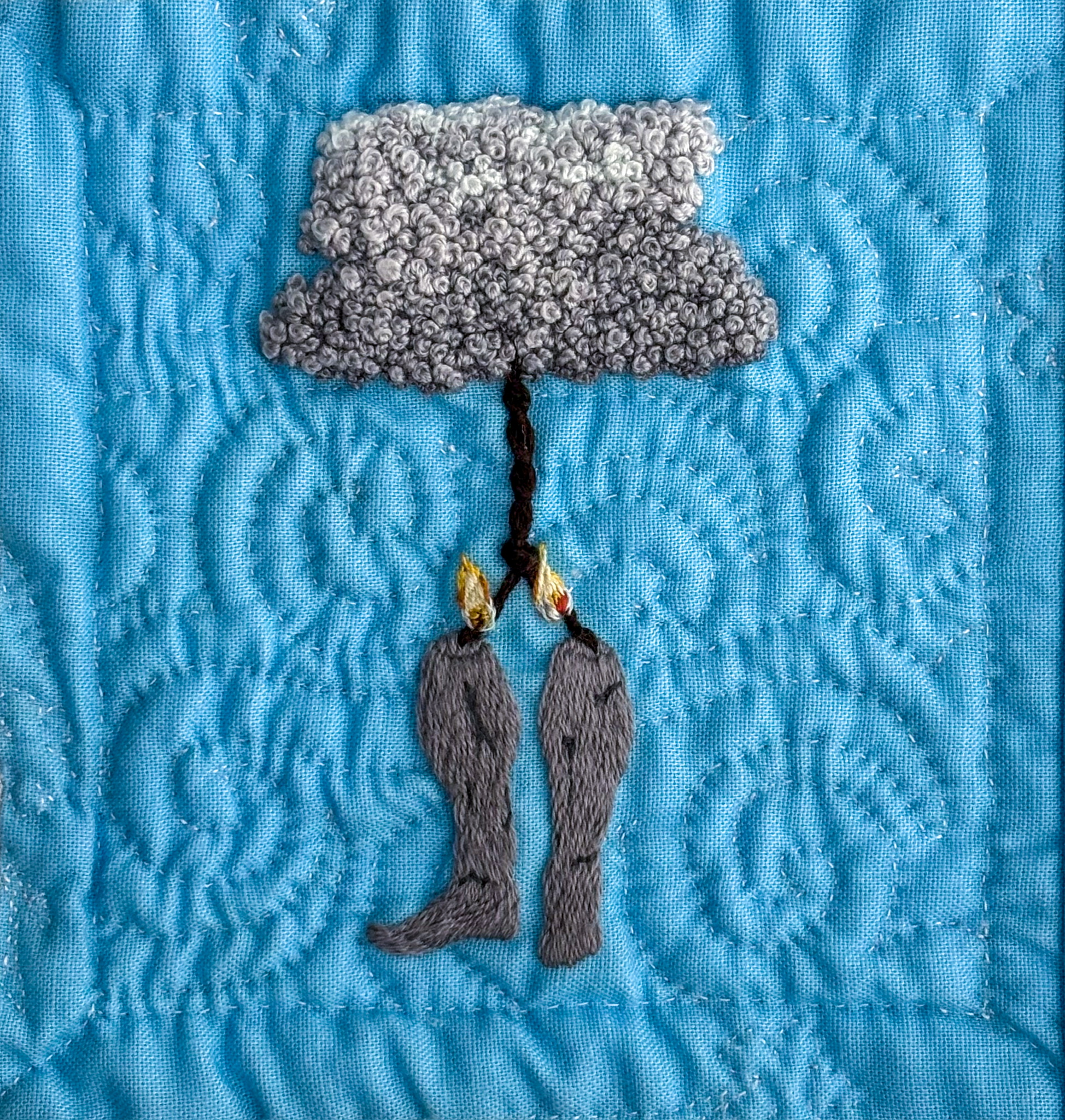
Cracked, concrete lower legs dangle by braided rope from a grey, textured cumulonimbus. Embroidered on blue cotton, twin flames lick up the ropes to the knot where they join.

PEM

A symptomatological embroidery of post exertional malaise, a hallmark of M.E.

Reducing the body to symbols, it depicts a crash with severe or very severe M.E.:

poisoned, intolerant of stimuli, intense pain down to the bone;

fluish, buzzing, turning to stone from the feet up:

a void beyond time and thought.

Back to Top


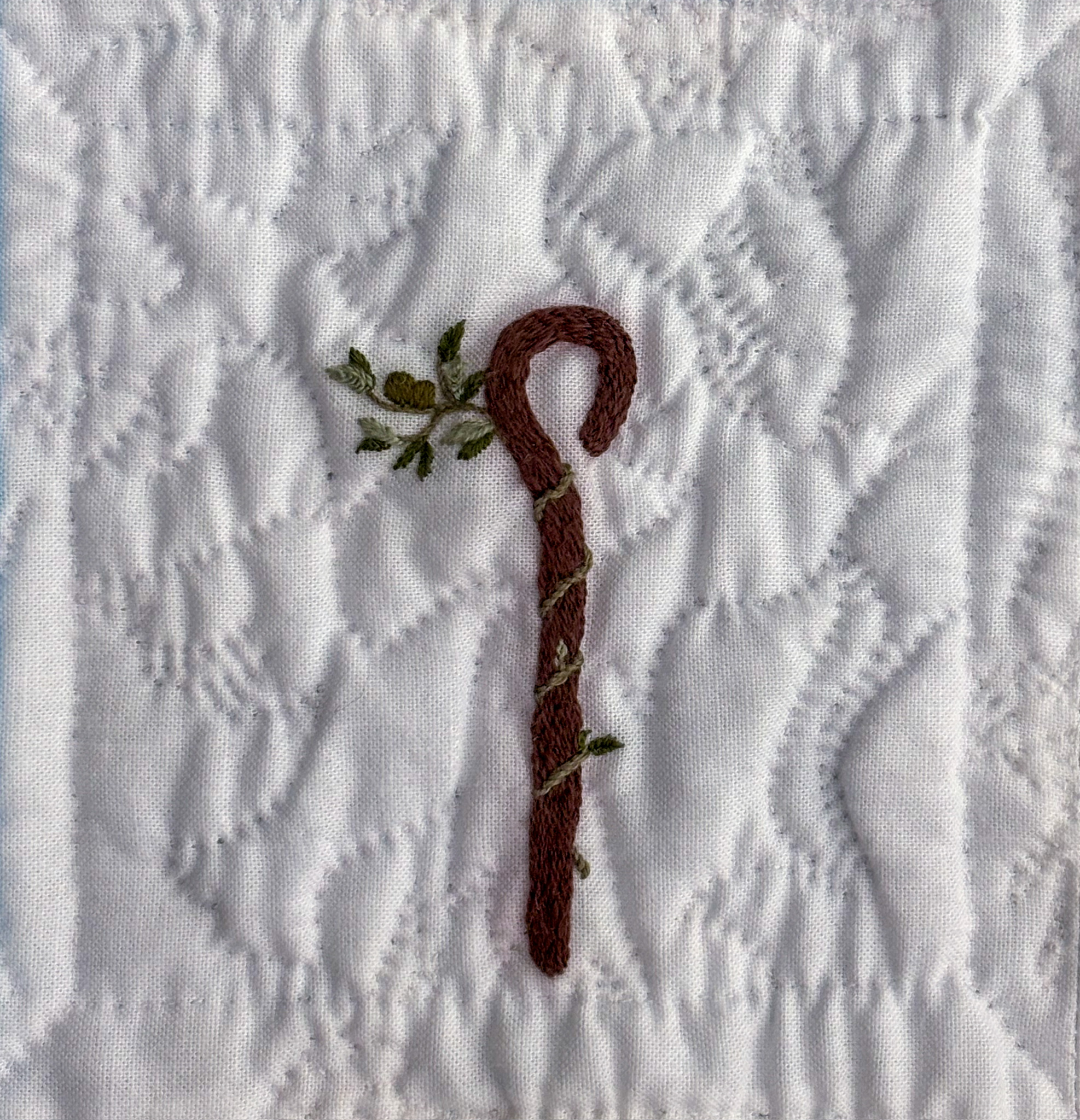
A brown olive branch with three leafy offshoots and a cluster of olives climbing a brown crook embroidered on white cotton.

Hope

This piece examines the theological tension of disability and faith through the iconography of a branch climbing a staff. It challenges stigma surrounding mobility aids by positioning the cane as provision: an enabling tool and a tangible sign of our interdependence.

In the Anabaptist tradition, the olive branch symbolizes hope, new life, and the aspiration for a global community of peace and care. Hope is a testament to the strength found in surrender: to my God, within my communities, and through the mobility aids that have facilitated my participation.

Back to Top


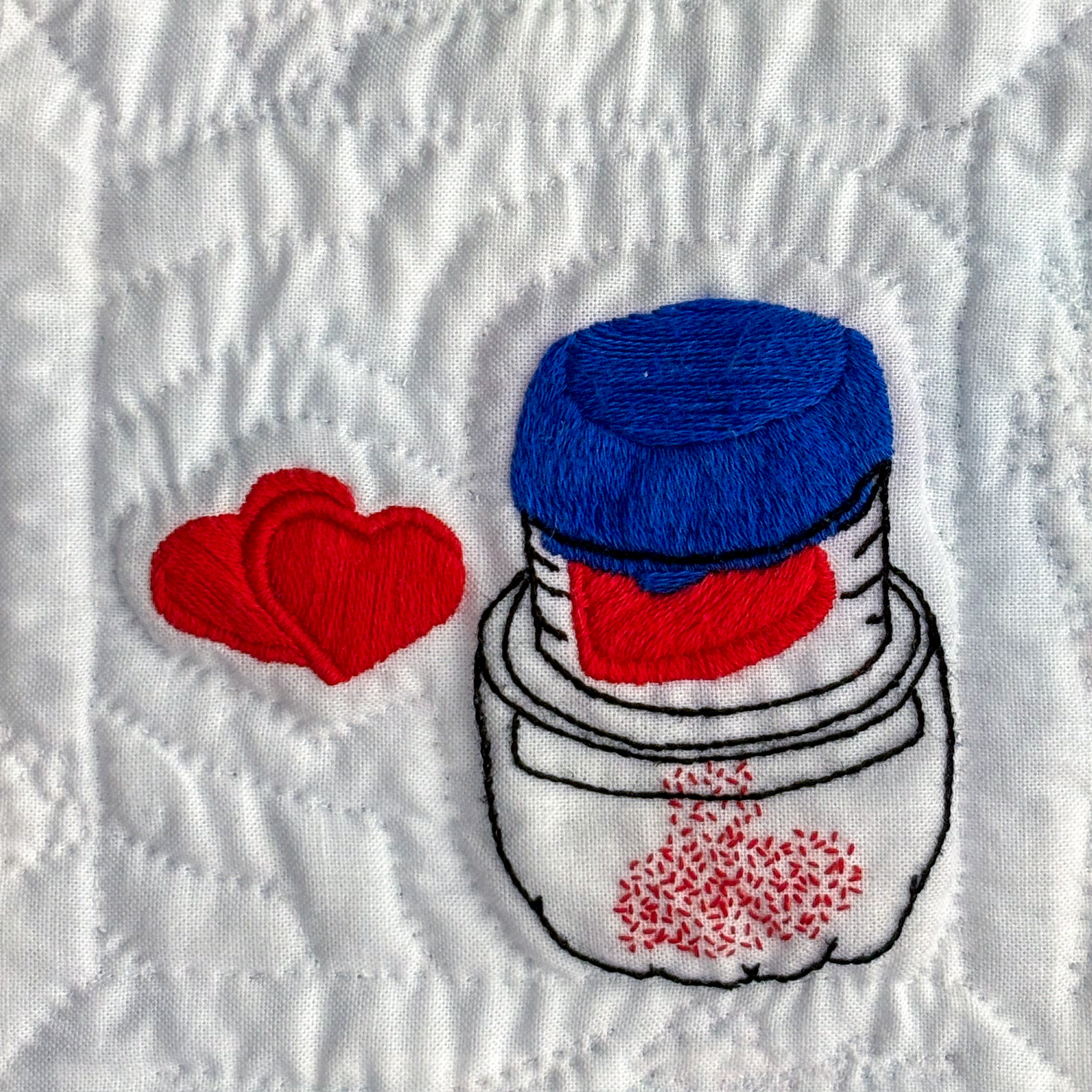
A clear pill crusher with blue lid and two small red heart pills embroidered on white cotton. A similar pill sits in the upper compartment as red particles fall to the lower compartment.

Bitter Pill

Healthcare’s bifurcated promise of hope and health in a system inducing anguish and injury. This is not meant as an indictment of healthcare workers, but as critique of a system that is uninformed about M.E. and poorly equipped to deal with chronic illness.

Even though I’ve had many great people as doctors and nurses who have cared for me, in my position of privilege I’ve still consistently been seen as hysterical, referred to psych, encouraged to exercise, prescribed graded exercise therapy (GET), refused access to tests and treatments, and denied medical nutritional interventions.

I’m so grateful to now be on low-dose naltrexone and receiving jejunal tube feeds. I’m also very grateful for the nurses who advocated for me and the doctors who worked with me to manage my health.

Back to Top


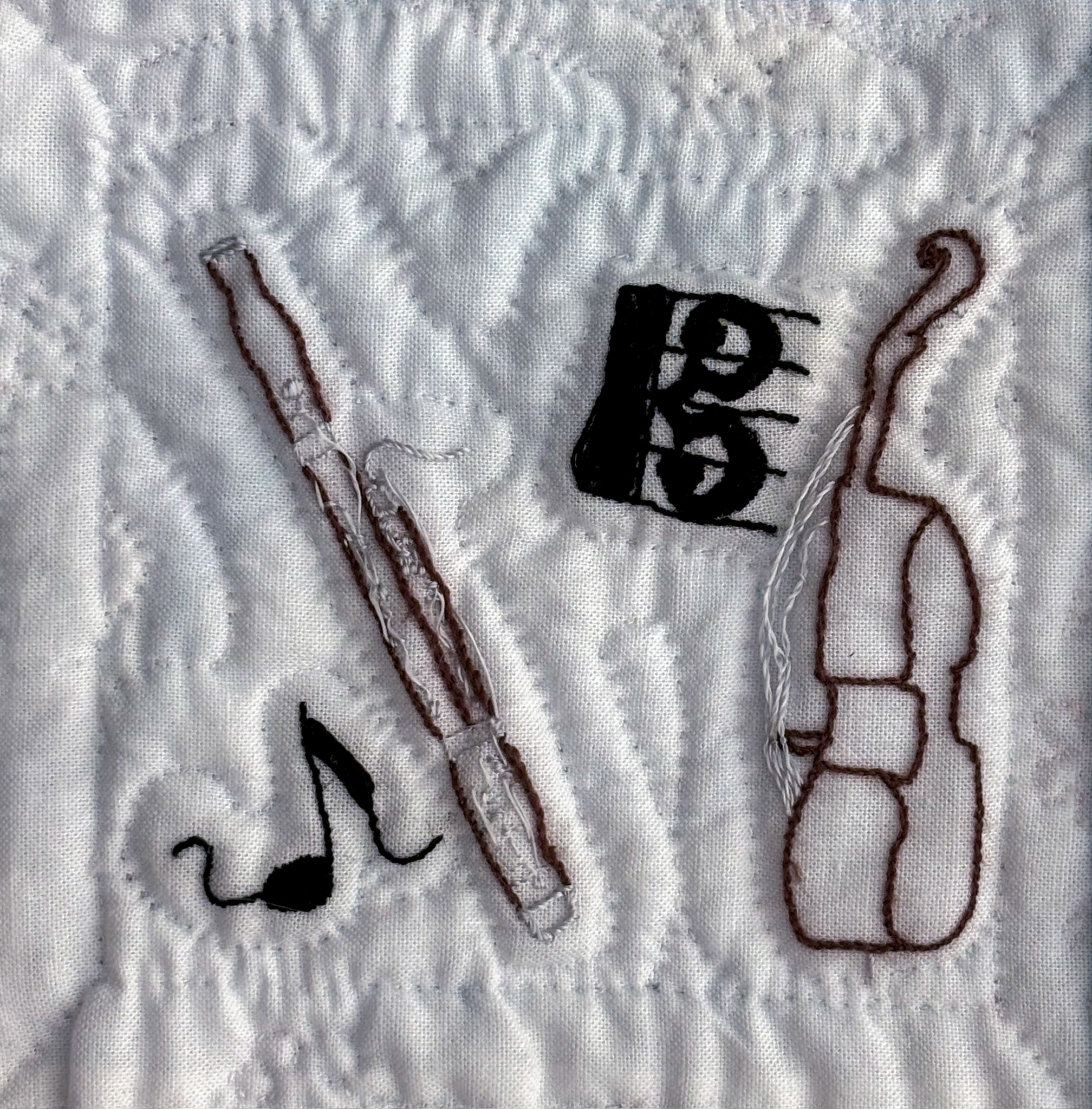
Bassoon and bass outlined in brown with silver accents embroidered on white cotton. Amongst them are a trailing eighth note and an alto clef filled in black.

Echoes

I love music and was pursuing it seriously. As a toddler, I would chant and dance to French nursery rhymes. Later, when first allowed to play the bassoon, I learnt quickly and practiced furiously. In high school I was given the opportunity to play the upright bass in Jazz and greatly enjoyed it, though my fingers would collapse. I remember recording my university audition, only able to play five minutes at a time.

Now I’m aware of how fortunate I am to listen so often to audio and mouth along.

Back to Top


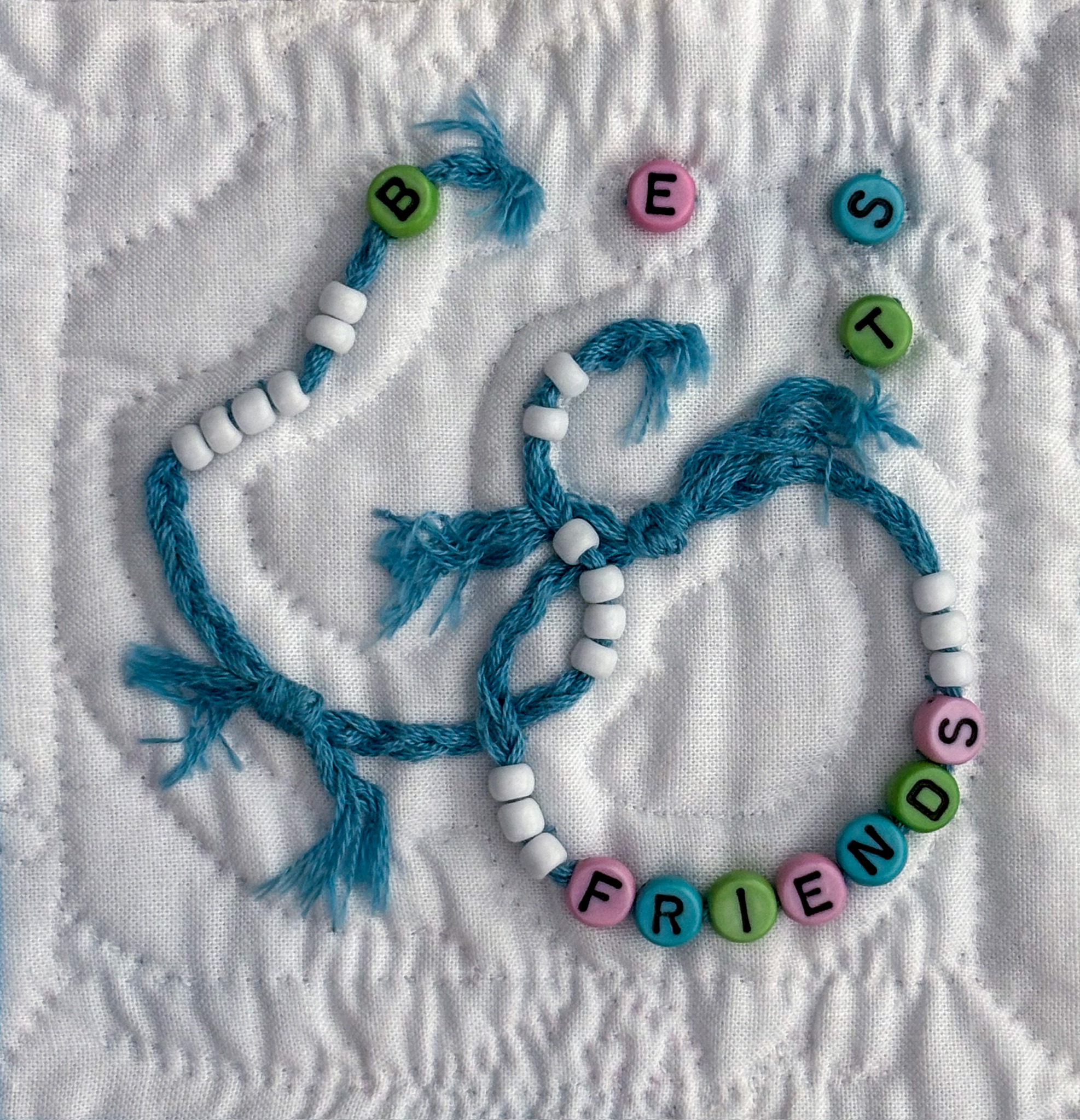
Two interlocking friendship bracelets appliquéd on white cotton. The “BEST” bracelet has burst, scattering the letter beads. The “FRIENDS” bracelet remains intact.

Travail

Travail conveys fractured relationships and the qualities of those which palingenesized.

When I became unfit to leave my house, my relationships were impacted. Many ended, either suddenly or gradually. Others have attenuated, though unwilling or unable to comprehend M.E. The best have adapted as my life and theirs have changed.

Though there are aspects to mourn, my friends are of immeasurable value.

Back to Top


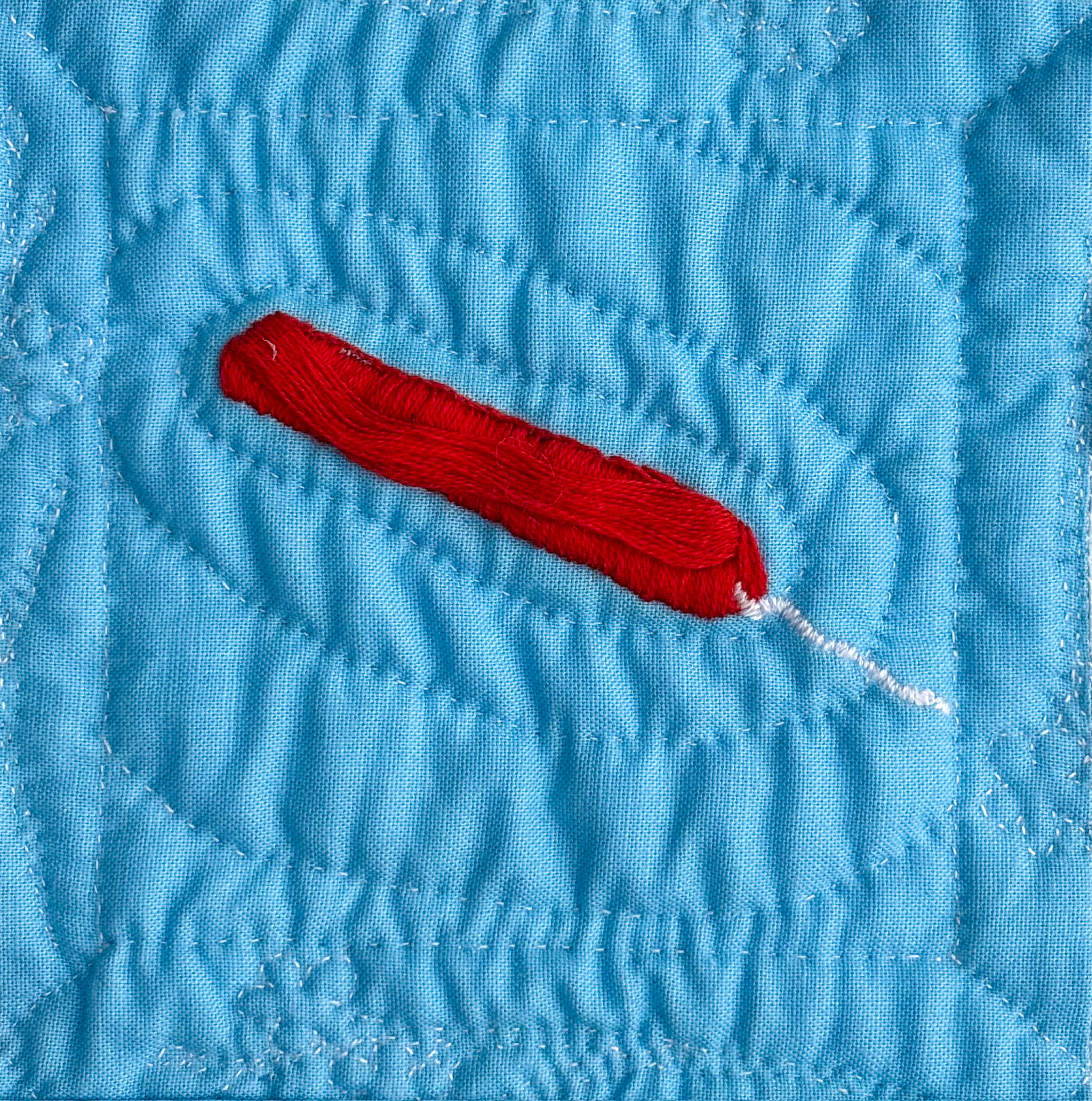
An embroidered rescue flotation device on blue cotton.

Counterpoint

This piece explores the juxtaposing identities of acquired disability through the ambiguous perspective.

I’ve always loved the water and was qualifying to be a lifeguard, pushing through post-exertional malaise (PEM) when I became unable to continue. Counterpoint depicts a superposition of the rescuer and the one in need of rescue.

Back to Top


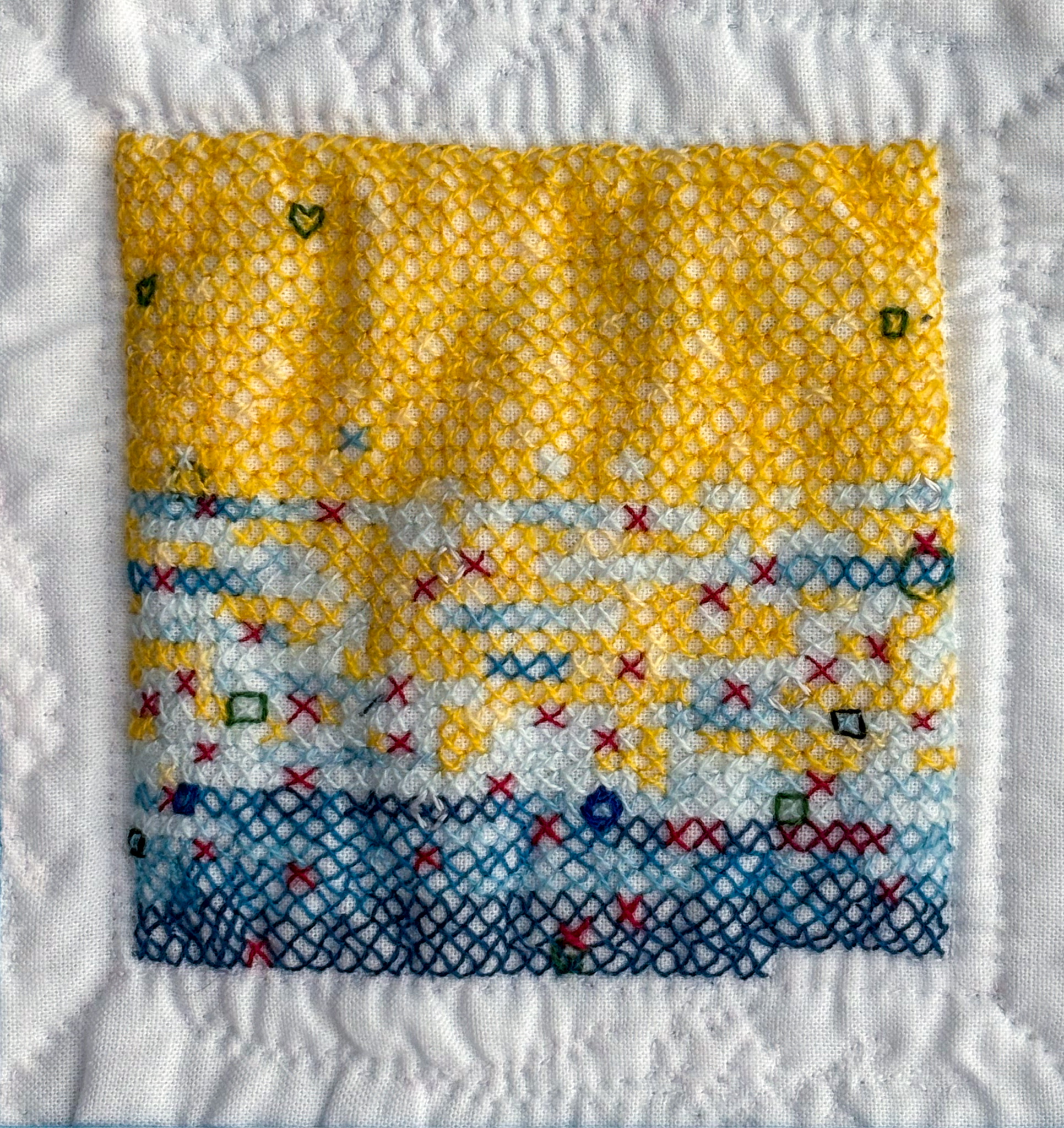
An abstract cross-stitch with a gradient from dark yellow falling into dark blue on white cotton, throughout which shapes such as hearts, stars and squares the size of one full stitch and a few red stitches are scattered.

Elements

A data-embroidery chronology of my well-being, using symbols to identify intellectual, social and spiritual milestones.

Each stitch represents one week. The color gradient highlights my physical degradation.

Back to Top


About the Artist

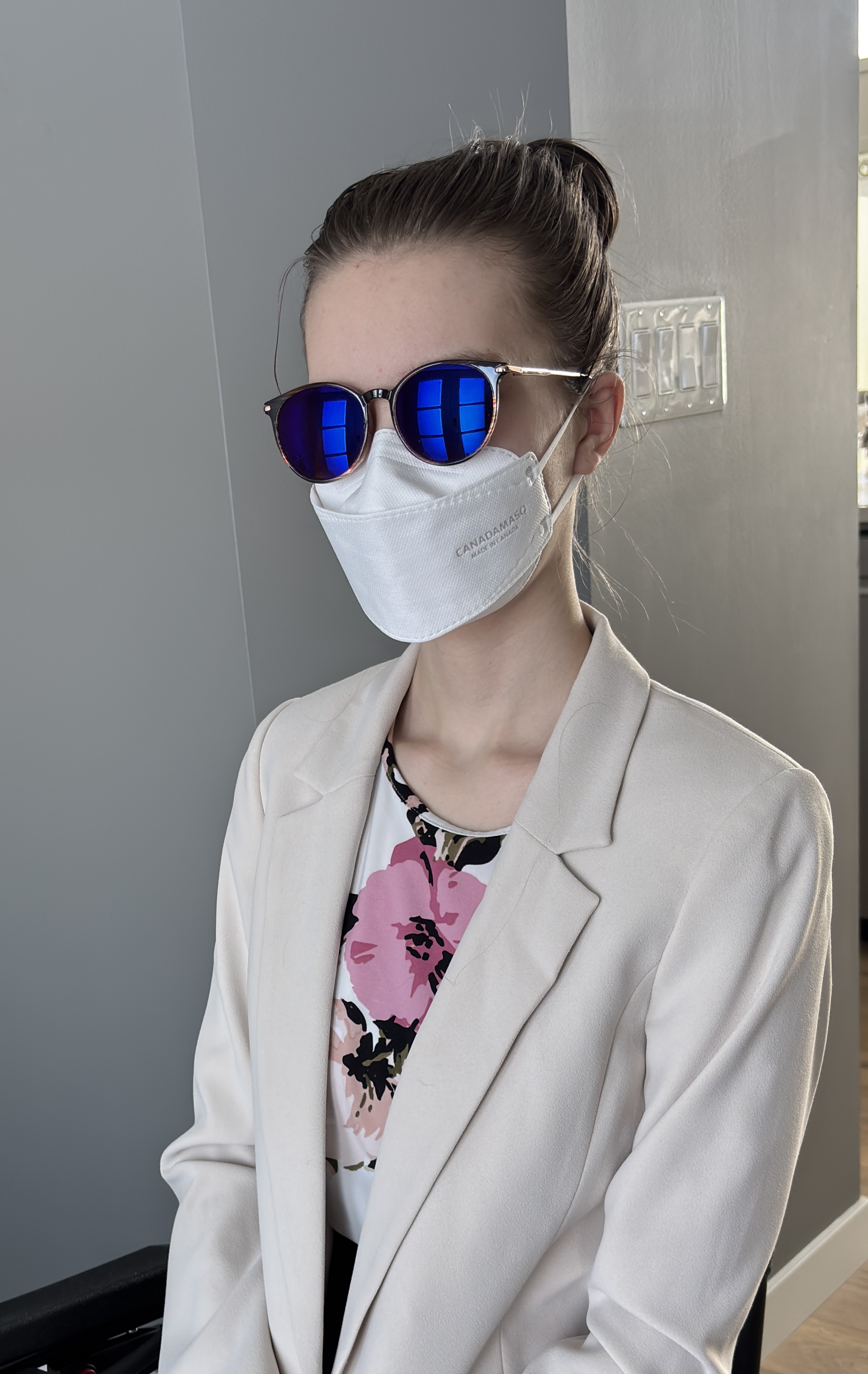
Adrienne Andres is a textile artist from Manitoba, Canada whose narrative practice sits at the intersection of traditional craft and contemporary art. Having navigated Myalgic Encephalomyelitis (M.E.) since middle school, Adrienne’s declining health led her to transition from a Bachelor of Music to a recumbent, collaborative craft. Following her 2022 diagnosis, she has focused her limited energy on embroidery and quilting as a means to explore identity, grief, and hope through a Disability Justice lens. Her current initiative, the Forget M.E. Not collective quilt, validates and amplifies the often-unseen experience of the M.E. community. Through storytelling, Adrienne strives to transform personal isolation into communal consolation and advocacy for visibility and systemic change.